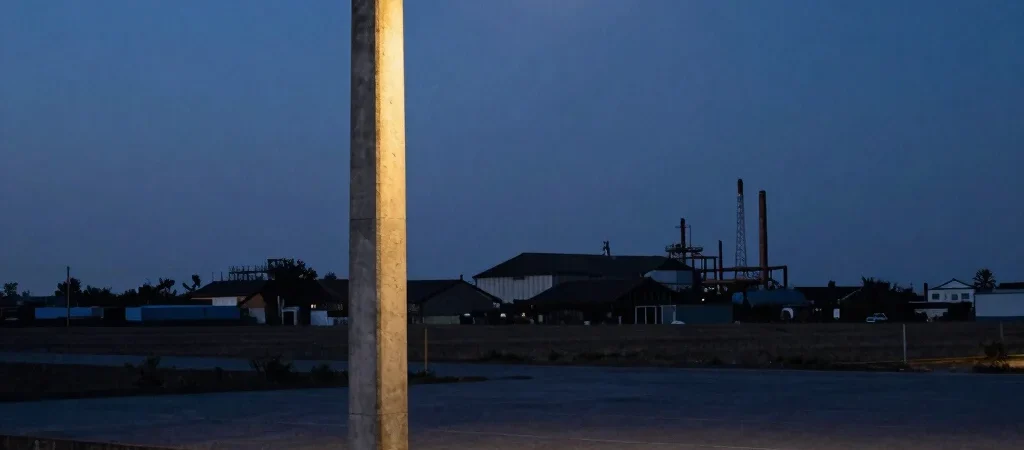
Across the arterial ring roads and distribution corridors of the West Midlands, isolated pockets of legacy sodium lighting still hold their ground against modern solid-state schemes. These survivors, often perched on slender concrete standards installed during late-twentieth-century industrial expansions, offer an authentic glimpse of roadside illumination as it functioned for decades. Recording them requires patience and systematic observation before maintenance schedules replace them for good.
Concrete Columns and Heavy Lantern Mountings
The physical presence of these installations owes much to the sheer weight of their auxiliary gear. Running a 135-watt or 180-watt low-pressure sodium tube required bulky step-up autotransformers and power-factor correction capacitors, frequently housed within base compartments of heavy prestressed concrete columns. The sheer mass of the spigot assemblies and angled outreach brackets gives these older columns an unmistakable silhouette against the twilight sky.
Weathering Patterns on Classic Aluminium Canopies
Decades of exposure to road spray, industrial particulate, and winter frost leave distinct archival marks on vintage lanterns. Die-cast aluminium canopies develop a fine matte patina, while acrylic bowls turn subtly milky or weather into delicate micro-crazing around hinge clasps. Far from diminishing the equipment, these surface variations tell the story of robust engineering that operated through decades of British winters with little more than lamp changes.
Documenting Details Before Replacement
For the enthusiast, field documentation should capture not only the luminaire profile during daylight hours but also the illumination footprint on the roadway below. Note the bracket rake, the optical cutoff angle, and whether the fitting retains an original two-part photocell or modern electronic switching head. Each detail preserves an accurate historical record of how sodium discharge shaped the night-time landscape of our industrial routes.